
The next chapter of GEOFLEX intellectual property.
GEIOS announces an updated U.S. provisional patent application for the expanded GEOFLEX concept. The company identifies the filing as U.S. Provisional Patent Application No. 64/103,327 at the United States Patent and Trademark Office (USPTO), with attorney docket TPP101381. The expanded concept brings DC-to-DC energy transfer, fleet management and coordinated geothermal generation and storage into a single operating architecture.
According to GEIOS, the previous concept was patented in Japan and France. The updated U.S. filing addresses the next generation of the GEOFLEX concept: an integrated, standalone energy network that connects the geothermal resource, battery charging, mobile delivery and customer demand.
Application reference: 64/103,327. Attorney docket: TPP101381. These are distinct identifiers; the docket is an attorney reference, not a patent number. The U.S. filing is a provisional application, not an issued U.S. patent.
A geothermal charging source. Not a grid-dependent charger.
GEOFLEX starts with a suitable, validated well. Proprietary GEIOS stimulation and heat extraction capture subsurface heat through the geocasing architecture. A thermal working fluid carries that energy to the surface, where heat exchange feeds a separate Organic Rankine Cycle (ORC).
The ORC expander drives a DC-generation assembly inside the transportable surface pod. The result is an electrical architecture designed around battery charging and compatible DC supply. GEOFLEX is standalone: its core generation, charging and delivery operation does not require a utility-grid connection. The geothermal well remains in place; the surface equipment and stored energy have different roles and different mobility.
DC-to-DC is the backbone—not a shortcut around protection.
Regulated DC-to-DC conditioning connects generation with the batteries. It manages the appropriate voltage and charge limits under battery-management supervision, avoiding an unnecessary external AC-generation and rectification detour before storage.
Compatible DC interfaces also support mobile-to-stationary battery replenishment. Voltage matching, electrical isolation where required, switching, monitoring and protection remain engineering requirements. DC-native does not mean zero loss: thermal conversion, power electronics and batteries still have losses. Customers that need AC receive it through suitable load-side inversion.
Fixed storage anchors the hub. Mobile storage extends its reach.
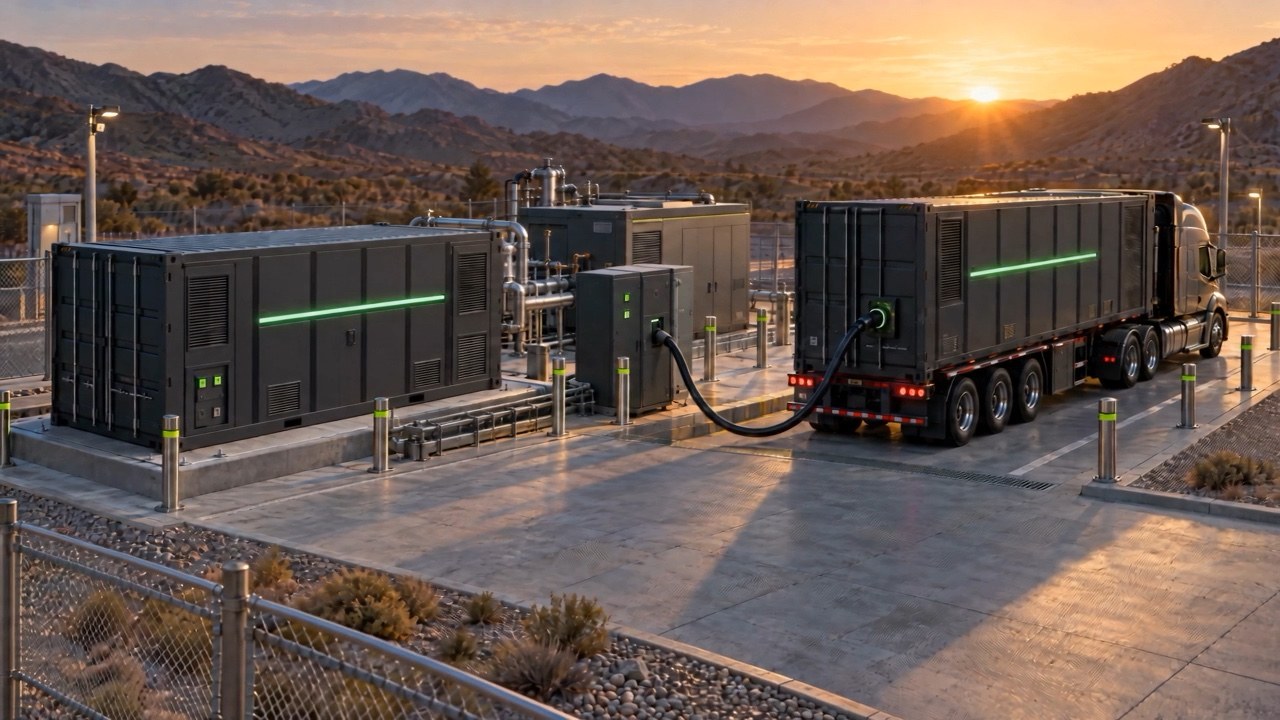
Fixed Battery Energy Storage Systems (BESS) provide a buffer at the geothermal charging hub. Nomad mobile BESS units charge at that source, carry stored electricity to a customer site, and connect for a controlled transfer to stationary site storage. The mobile unit then returns to recharge while the customer’s fixed battery supplies the load.
This separates where energy is produced from where it is used. The fleet transports stored electrical energy—not a geothermal reservoir or a heat-producing generator operating on the road. The concept combines the well, geocasing, heat exchange, ORC/DC pod, charge conditioning, fixed BESS, mobile BESS and customer-side storage rather than treating them as isolated products.
Fleet management turns equipment into an energy network.
The expanded concept coordinates generation, charging, storage and mobile dispatch. A unified management layer is designed to use battery state of charge, operating limits, available generation, customer demand, site reserves and delivery timing to decide how stored energy should be allocated.
Fleet planning brings route duration, charging turnaround and mobile-unit availability into the same picture as customer replenishment. Battery-management systems supervise each connected transfer; monitoring and energy metering support visibility into charging and delivered energy. The aim is to manage both the electrical pathway and the physical movement of batteries as one coordinated service.
Fleet size, telemetry interfaces, dispatch logic, metering equipment and reserve requirements are engineered for each project. These are elements of the proposed architecture, not claims of an already deployed fleet or a certified universal operating result.
One platform. Different customer pathways.
EV charging hubs can use local geothermal charging or mobile replenishment of stationary batteries. Data-center configurations can separate dedicated IT reserves from cooling, lighting and other building services, with suitable DC conditioning toward the racks. Mining and industrial operations can combine local resources with delivery from a remote hub. Hospitals and critical infrastructure can be designed around protected critical loads, site reserves and appropriate redundancy.
A charging hub may also be located within a city when a suitable well and site are available. Every documented well with temperature data is a candidate for assessment, not an automatically validated asset. Undocumented wells require thermal-camera assessment, structural evaluation and an on-site visit before validation and acquisition. Usable heat, well integrity, ownership, access, permissions and demand determine whether a project can proceed.
What makes the GEOFLEX concept different.
The distinction is the integration: a geothermal charging source, a DC-native conversion and transfer path, storage at both ends, transportable energy, and fleet-aware dispatch. Generation follows the resource; delivery follows the customer. Together, these elements define GEIOS’s proposed alternative to a grid-dependent charging and supply model.
The website explains the architecture at a high level without disclosing confidential stimulation chemistry, geocasing internals or patent documents. Deployment performance and continuity must be validated against the actual resource, load, storage capacity and route plan. For technical or partnership discussions, contact contact@geios.energy or connect with GEIOS GEOFLEX at 4200 San Jacinto St., Houston, TX 77004.